
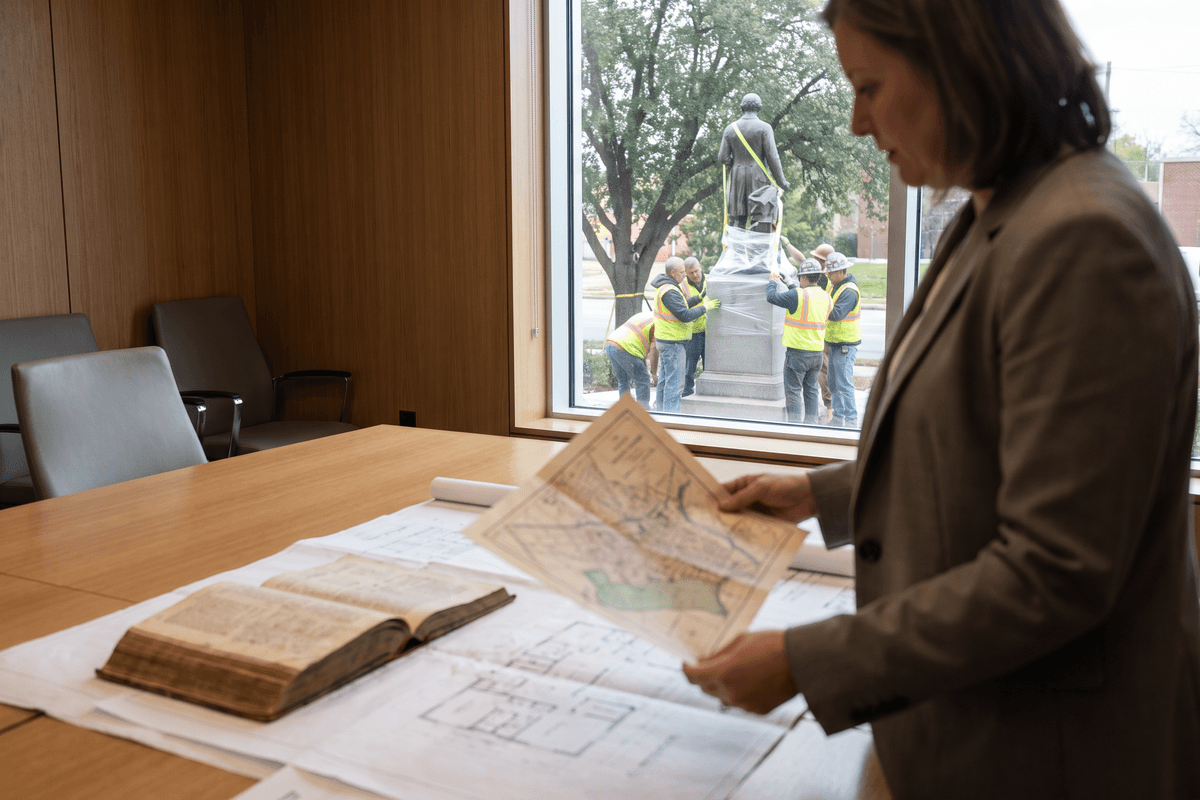



For municipal leaders across Canada, public art and historical monuments have transitioned from benign civic beautification projects into complex flashpoints of cultural, political, and historical debate. When a municipality decides a monument no longer aligns with its contemporary values or its commitment to reconciliation, a new, often unaddressed administrative headache begins: what exactly do you do with a multi-ton bronze or stone asset once it has been removed from the public square?
A compelling answer is currently emerging from the City of Orillia, Ontario. According to a recent report from CHCH, several Quebec municipalities and Franco-Ontarian communities have formally expressed interest in acquiring a controversial statue of Samuel de Champlain that Orillia removed from a local park in 2017. The statue, which drew criticism for its colonial imagery and depiction of Indigenous peoples, has spent the last several years languishing in municipal storage.
This development offers a fascinating precedent for municipal administrators, Chief Administrative Officers (CAOs), and city councils nationwide. It highlights the potential of inter-municipal and inter-provincial transfers as a pragmatic policy solution for managing contested cultural assets.
The Financial and Political Burden of 'Monument Purgatory'
When public pressure mounts to remove a controversial monument, the immediate focus is almost entirely on the act of removal itself. However, municipal clerks and facility managers know that taking a statue off its plinth is only step one. What follows is often a prolonged period of "monument purgatory."
Storing large-scale public art is not free. Municipalities must account for:
- Secure Storage Costs: Statues require climate-controlled or at least secure environments to prevent degradation and vandalism.
- Insurance Liabilities: High-value bronze or historical artifacts must remain insured, even when hidden from public view.
- Administrative Drag: Unresolved assets remain recurring agenda items for city councils, consuming valuable debate time and staff resources for ongoing reports.
"The removal of a monument does not erase the administrative responsibility of the municipality to manage the asset. Finding an equitable, culturally sensitive, and fiscally responsible final disposition is often the hardest part of the process."
In Orillia's case, the Champlain statue has been in storage since 2017. The holding pattern represents a common paralysis in municipal governance: the fear that destroying the asset will outrage heritage advocates, while reinstalling it will betray commitments to Indigenous reconciliation.
The Inter-Municipal Transfer Solution
The interest shown by Quebec municipalities and Franco-Ontarian communities introduces a creative off-ramp. Samuel de Champlain holds a highly contested legacy in areas where the focus is on his colonial interactions with Indigenous populations. Conversely, in francophone regions, Champlain is frequently celebrated as a foundational figure of French language and culture in North America.
By transferring the statue to a jurisdiction where its historical context is interpreted differently—or where the receiving municipality is willing to take on the burden of contextualizing the piece—both municipalities stand to benefit. Orillia resolves a local controversy and unloads an administrative burden, while the receiving community acquires a significant historical artifact at a fraction of the cost of commissioning a new one.
Policy Frameworks for Deaccessioning Public Art
To facilitate these kinds of solutions, municipalities must proactively update their public art and heritage asset policies. Many local governments have robust policies for acquiring art, but severely lack clear frameworks for deaccessioning (removing and disposing of) it.
A modern deaccessioning policy should include:
- Clear Criteria for Removal: Establishing thresholds for when an asset can be removed (e.g., public safety, severe structural degradation, or conflict with established municipal human rights/reconciliation frameworks).
- A Hierarchy of Disposition: Outlining the preferred methods of disposal. This usually flows from relocation within the municipality, to offering it back to the artist/donor, to inter-municipal transfer, to public auction, and finally, destruction or recycling.
- Community Consultation Mandates: Ensuring that the decision to transfer an asset involves dialogue with the communities most impacted by the monument's imagery.
Comparing Disposition Strategies for Contested Assets
To understand where inter-municipal transfer fits into the broader municipal toolkit, it is helpful to compare the standard strategies currently employed by Canadian local governments.
| Strategy | Pros | Cons | Municipal Example |
|---|---|---|---|
| Indefinite Storage | De-escalates immediate public tension; buys time for consultation. | Ongoing storage and insurance costs; leaves the policy issue unresolved. | Orillia (Champlain, 2017-Present) |
| Recontextualization | Keeps the asset public; adds educational plaques or counter-monuments to provide historical truth. | Requires extensive, often painful public consultation; can fail to satisfy either side of the debate. | Various municipalities attempting to contextualize Egerton Ryerson or Sir John A. Macdonald. |
| Inter-Municipal Transfer | Removes the local burden; preserves the historical artifact; finds a culturally appropriate home. | Logistical costs of transport; requires finding a willing partner municipality. | Proposed Quebec/Franco-Ontarian acquisition of Orillia's Champlain. |
| Museum Relocation | Shifts the item from a place of civic reverence to a place of historical education. | Many local museums lack the physical space or mandate to take large-scale monuments. | Victoria (Sir John A. Macdonald - ongoing discussions). |
Logistical Considerations for Cross-Border Transfers
If Orillia's city council approves the transfer of the Champlain statue to a Quebec or Franco-Ontarian municipality, administrators will need to navigate several logistical hurdles. Municipal professionals should take note of these steps for future planning:
- Valuation and Legal Transfer: Even if a statue is "gifted" to another municipality, it must be properly valued for accounting purposes. Legal agreements must be drafted to absolve the originating municipality of future liability and outline who bears the cost of transportation.
- Transportation Logistics: Moving a multi-ton bronze statue safely requires specialized heritage movers, road permits, and significant coordination between the public works departments of both the sending and receiving municipalities.
- Public Relations Strategy: The narrative surrounding the transfer must be carefully managed. The originating municipality must communicate that this is a respectful resolution, not a "dumping" of a problem onto another community.
Looking Ahead: A Maturing Approach to Heritage
The situation in Orillia highlights a maturing approach to how Canadian municipalities handle the complex legacy of public monuments. Moving away from the binary choices of "leave it up" or "tear it down," local governments are beginning to view these monuments as movable assets whose meaning is heavily dependent on their geographic and cultural context.
By fostering inter-municipal cooperation, local governments can support each other in navigating the difficult waters of historical reckoning and public space management. As Orillia's city council deliberates the final destination of the Samuel de Champlain statue, municipal leaders across the country should watch closely. The outcome may very well write the blueprint for how Canada's cities manage the controversial monuments of tomorrow.