Controlling emotions, addressing bias, and implementing vigorous analysis to lead through a crisis
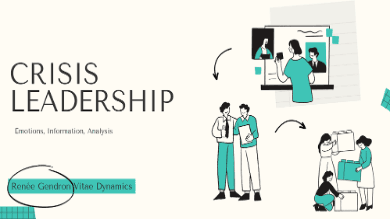
Crisis leadership occurs when there is a threat to the continued existence of the organization. Leaders must navigate tense emotions and conflicting information and select an appropriate strategy to execute.
Students will learn the stages of a crisis and how to identify which stage they are in.
In section one, students will learn how to regulate emotions. Crises are difficult and tense times that cause stress and uncertainty and drain morale. Leaders who can manage their emotions project more authority and confidence to their teams and organizations. This course will also provide steps on how to compartmentalize their emotions.
In section two, students will learn how to triage information, how to define the scope of the crisis and common cognitive biases. Halo and horn biases are among those reviewed. Students will learn how to maintain perspective.
In section three, different types of analysis are introduced to enable leaders to think about a crisis in different ways. In this section, students will learn about open and closed systems and different analytical tools such as Porter’s Five Forces, speed vs patience, and SWOT.
Students will learn what is an elegant and eloquent solution to a crisis.
In section two, students will learn how to triage information, how to define the scope of the crisis, and common cognitive biases. Halo and horn biases are among those reviewed. Creating a robust solution requires reality checks to ensure the conditions that created the crisis aren’t replicated.
All solutions must be both elegant and eloquent.
In section three, different types of analysis are introduced to enable leaders to think about a crisis in different ways. In this section, students will learn about open and closed systems and different analytical tools such as Porter’s Five Forces, speed vs patience, and SWOT.

Renée Gendron is a trainer and consultant. She helps companies become resilient and robust through conflict management, leadership development, and business ecosystem development. She speaks on leadership, conflict resolution, and business and economic trends. She can be reached at renee@vitaedynamics.com
This portal is provided as a training and development resource for City of Markham employees. Every course is delivered by a qualified subject matter expert or learning organization, is quantifiable in hours, and is verifiable — you receive a documented certificate of completion for every course you finish, stored on LearnFormula indefinitely.
If you hold a professional designation (for example in engineering, accounting, human resources, or law), courses may be counted as professionally relevant, verifiable learning activities toward your continuing professional development. Individual practitioners are responsible for confirming that an activity meets the requirements of their professional body. For questions about the City of Markham's training and development policies, please speak with your people leader or Human Resources.
