Mastering Substation Bus Fault Protection: Configurations and Critical Protection Criteria
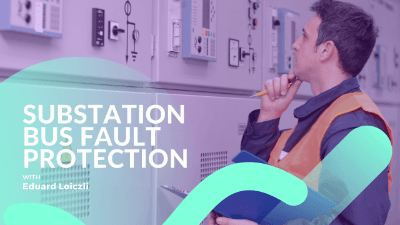
After successfully completing the "Substation Bus Fault Protection" course, students will learn the major types of BUS configurations and the most important criteria for protecting the BUS in Medium Switchgear and High Voltage Switchyards.
This detailed course covers the essential aspects of substation bus fault protection, focusing on various configurations, protection types, and the influence factors that affect protection design. Participants will gain a comprehensive understanding of zones of protection, differential protection schemes, and the implementation of high impedance and percentage differential protection. The course also explores dynamic bus configurations, zone interlocking and blocking schemes, and the integration of grounding transformers for enhanced protection. Additionally, the course addresses breaker failure logic and the expansion of bus differential protection to ensure robust and reliable operation of substations. Designed for electrical engineers and substation maintenance professionals, this course equips attendees with the knowledge and skills to effectively manage and protect substation bus systems.
35 years of Power Engineering & Control. Specialized in power, control, automation, instrumentation, nuclear. My name is Eduard Loiczli, Doctor Engineer in Electrical Engineering. I started programming Rockwell PLC's in 1991 and since then I have programmed and integrated many Automation Systems which required motion control, automation HMI Control and complex multitasking. I've also taught at many reputable schools. For all who are looking to learn fast and in depth Rockwell Automation, this introductory course is one in a series of four courses to launch you into a better understanding of Automation and Control. Email: eduard.loiczli@apcacademy.ca
This portal is provided as a training and development resource for City of Markham employees. Every course is delivered by a qualified subject matter expert or learning organization, is quantifiable in hours, and is verifiable — you receive a documented certificate of completion for every course you finish, stored on LearnFormula indefinitely.
If you hold a professional designation (for example in engineering, accounting, human resources, or law), courses may be counted as professionally relevant, verifiable learning activities toward your continuing professional development. Individual practitioners are responsible for confirming that an activity meets the requirements of their professional body. For questions about the City of Markham's training and development policies, please speak with your people leader or Human Resources.
