Master the quantitative analysis of geological structures and stress fields to solve complex challenges in resource exploration, engineering stability, and groundwater dynamics.
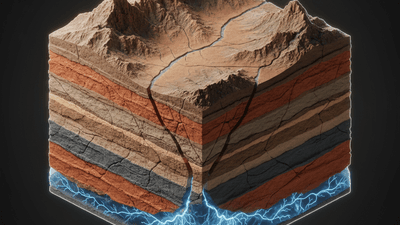
Master the complex physical behaviors of the Earth's crust with this comprehensive course, Structural Geology, Hydrogeology & Rock Mechanics. Designed for geoscientists, civil engineers, and mining professionals, this curriculum offers a rigorous exploration of how rock masses deform, fail, and interact with subsurface fluids. By integrating geometric analysis with mechanical theory, learners will develop the critical skills necessary to interpret geological structures and ensure the stability of engineering projects.
The module begins with the geometric foundations of structural geology, establishing rigorous definitions for structural planes and linear features. You will progress through advanced visualization techniques, utilizing stereographic projections (Wulff and Schmidt nets) to solve complex three-dimensional problems involving rotational analysis, angular unconformities, and tectonic history reconstruction. The course dives deep into the morphology and mechanics of folding—analyzing parallel, similar, and superposed folds—and provides a detailed examination of fault kinematics, distinguishing between separation and true net slip vectors using piercing points.
In the realm of Rock Mechanics, the content shifts to the quantitative analysis of stress and strain tensors. You will explore fundamental failure criteria, including the Griffith and Modified Griffith theories, and utilize Mohr circles to predict rock fracture under various confinement conditions. The curriculum addresses critical real-world challenges such as mechanical anisotropy in tectonites, the destabilizing effects of pore fluid pressure, and the time-dependent behavior of rock creep. Practical engineering applications are emphasized throughout, covering excavation stability, tunnel design, support systems like rockbolting and steel arches, and advanced in-situ testing methods.
Bridging these disciplines, the Hydrogeology section focuses on the dynamics of groundwater flow and aquifer characterization. It emphasizes the pedagogical integration of field data collection with laboratory modeling to understand hydraulic conductivity and contaminant transport. By the end of this course, you will be equipped to:

Advanced CPD for Canada’s Engineering & Geoscience Community
Northern Geoscience Training Group is a Canadian continuing-education provider dedicated to delivering high-quality professional development for engineers and geoscientists. The organization specializes in bridging regulatory expectations, technical standards, and practical field knowledge within mineral exploration, environmental engineering, and resource development. Our courses are designed to help practicing professionals stay current with evolving Canadian standards, including NI 43-101 requirements, CIM best practices, and provincial regulatory guidelines. With a focus on applied geology, engineering integrity, and responsible reporting, the company supports lifelong learning across the natural-resource and infrastructure sectors.
This portal is provided as a training and development resource for City of Markham employees. Every course is delivered by a qualified subject matter expert or learning organization, is quantifiable in hours, and is verifiable — you receive a documented certificate of completion for every course you finish, stored on LearnFormula indefinitely.
If you hold a professional designation (for example in engineering, accounting, human resources, or law), courses may be counted as professionally relevant, verifiable learning activities toward your continuing professional development. Individual practitioners are responsible for confirming that an activity meets the requirements of their professional body. For questions about the City of Markham's training and development policies, please speak with your people leader or Human Resources.
