Turning molding rules into reliable structures - stiffness, strength, and long-term performance under real loads, temperature, and time.
Injection molding can produce strong, lightweight parts at scale - but structural failures often occur when designers treat molding "rules of thumb" as structural design rules. Ribs reduce deflection, bosses provide fastening and load paths, and thin walls improve cycle time - yet each feature can introduce sinks, warpage, stress concentrations, weld lines, and time-dependent deformation.
This advanced CPD webinar is built for professional engineers in Canada working in product development, machinery, building systems, industrial equipment, consumer products, and mobility. The course focuses on how to design injection-molded parts that meet structural requirements in service: how to size ribs and bosses without creating cosmetic or dimensional defects, how to manage load transfer through joints and fasteners, and how to account for creep and stress relaxation when parts see sustained loads and elevated temperatures.
The session is structured as a practical workflow that leaves room for the speaker to adapt examples to different polymers (unfilled and glass-filled thermoplastics), environments (heat, humidity, chemicals), and verification methods (hand checks, FEA, prototypes, and production test). Where standards are useful (e.g., creep test methods such as ISO 899 and ASTM D2990), we show how to translate material data into conservative design allowables and validation plans.

Sessional Faculty | University Canada West
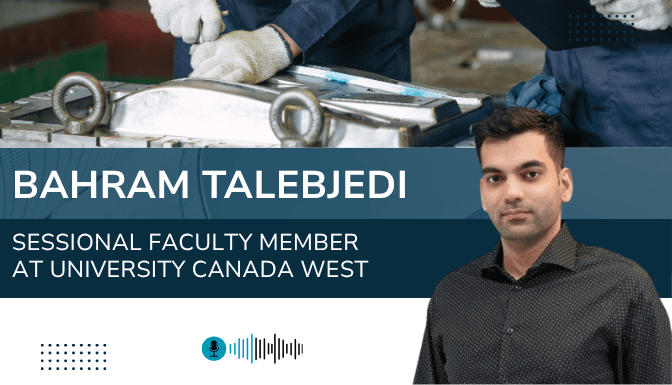
Bahram Talebjedi is a mechanical design engineer and educator with expertise in product development, injection-molded part design, and manufacturing optimization. He currently serves as a Sessional Faculty member at University Canada West and most recently worked as a Mechanical Design Engineer at Algo Communication Products Ltd., where he developed communication hardware products from concept through mass production. His work has focused on design for manufacturing and assembly (DFMA), injection molding, GD&T, SolidWorks modeling, and finite element analysis to create scalable, production-ready designs. Prior to his industry role, Bahram spent more than three years at The University of British Columbia as a Graduate Research Assistant and Teaching Assistant. There, he contributed to the design of a low-cost on-chip PCR device and supported courses in machine element design, energy system design, data analysis, and statistics. He combines academic and industry experience to bring a practical, engineering-driven perspective to product design, validation, and manufacturability.
This portal is provided as a training and development resource for City of Markham employees. Every course is delivered by a qualified subject matter expert or learning organization, is quantifiable in hours, and is verifiable — you receive a documented certificate of completion for every course you finish, stored on LearnFormula indefinitely.
If you hold a professional designation (for example in engineering, accounting, human resources, or law), courses may be counted as professionally relevant, verifiable learning activities toward your continuing professional development. Individual practitioners are responsible for confirming that an activity meets the requirements of their professional body. For questions about the City of Markham's training and development policies, please speak with your people leader or Human Resources.
