Master the core principles of geotechnical engineering to evaluate soil behavior, calculate safe foundation loads, and design resilient slopes for secure infrastructure projects.
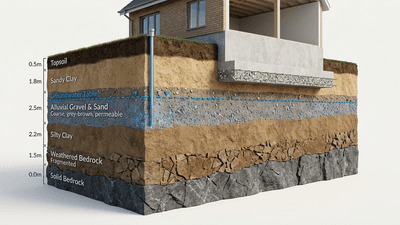
This 6.5-hour course covers soil investigation and classification, hydraulic and mechanical properties of soils, determining and increasing bearing capacity, and determining and increasing slope stability.
Delve into the critical principles of geotechnical engineering through an in-depth exploration of earth materials and their structural behaviors. This course provides a comprehensive overview of fundamental soil mechanics, focusing on the physical and mechanical properties that dictate how soils respond to applied environmental and structural forces.
The content thoroughly examines stress distribution, consolidation, and shear strength, forming a vital foundation for safe geotechnical design. Building upon these core concepts, the material investigates the mechanics of bearing capacity, detailing the analytical methods used to determine how different soil profiles support shallow and deep foundations.
Furthermore, the program explores the complex dynamics of slope stability, analyzing the underlying causes of slope failure and the modern engineering techniques utilized for effective earth retention and slope stabilization. This overarching review is designed to provide a deep, conceptual understanding of ground behavior, essential for the design and construction of safe, resilient, and sustainable infrastructure rooted in sound geotechnical principles.

Online Courses for Engineers
HalfMoon Education is a nonprofit continuing education provider offering live webinars and on-demand courses for engineers, architects, landscape architects, land surveyors, attorneys, paralegals, accountants and others. Since 1996, we’ve helped thousands of professionals nationwide stay current with industry standards and codes, earn CE hours, and advance their expertise through practical, expert-led learning experiences. Learn more about us at: www.halfmoonseminars.org

Director of Geotechnical Design Division at Earth Engineering Inc
Mr. McKelvey is the Director of the Geotechnical Design Division at Earth Engineering Inc. in East Norriton, Pennsylvania. He is a registered professional engineer (P.E.) in California, Delaware, Maryland, New Jersey, Pennsylvania, Virginia, and the District of Columbia. Mr. McKelvey is also a Diplomate (D.GE) of the Academy of Geo-Professionals and a Fellow of the American Society of Civil Engineers (F.ASCE). Mr. McKelvey has extensive experience in geotechnical engineering, including site assessment and field investigations, deep and shallow foundation design for buildings, bridges, and other structures, retaining wall design, embankment stability, mechanically stabilized soil structures, and subsurface hydrology. He also has significant experience in mitigating heavy construction claims and litigation support pertaining to impacted heavy construction projects. Mr. McKelvey has also handled construction support and construction quality assurance projects. His environmental engineering experience includes technical contributions to the remediation of many Superfund sites and over fifty landfill design projects. Mr. McKelvey has published over 30 technical papers in journals, conference proceedings, and trade magazines. He is currently the Past Chair for the Delaware Valley Geo-Institute (DVGI) and is a voting member in ASTM committees Soil and Rock (D18) and Geosynthetics (D35), and is an editorial board member of the Geotechnical Testing Journal. Mr. McKelvey also serves on two Geo-Institute committees: Earth Structures and Embankments and Dams, the latter of which he is a member of the subcommittee on landslide risk assessment.
This portal is provided as a training and development resource for City of Markham employees. Every course is delivered by a qualified subject matter expert or learning organization, is quantifiable in hours, and is verifiable — you receive a documented certificate of completion for every course you finish, stored on LearnFormula indefinitely.
If you hold a professional designation (for example in engineering, accounting, human resources, or law), courses may be counted as professionally relevant, verifiable learning activities toward your continuing professional development. Individual practitioners are responsible for confirming that an activity meets the requirements of their professional body. For questions about the City of Markham's training and development policies, please speak with your people leader or Human Resources.
