Intended Audience: This course is intended for civil and transportation engineers concerned with large road networks.
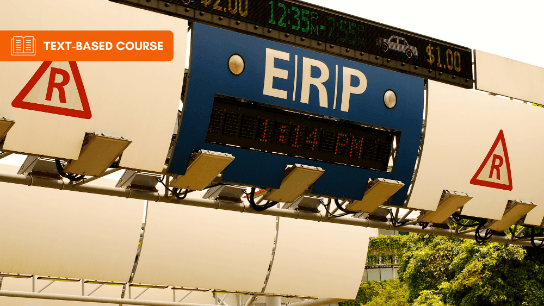
This engineering PDH online course presents the findings of a team of American transportation specialists who visited foreign countries (Sweden, the United Kingdom, Germany, the Netherlands, the Czech Republic, and Singapore) to identify road pricing practices (various user fees and tolls) that might be used to advantage in the United States. The team found road pricing methods that can be highly effective in managing demand and generating revenue and can also be politically and publicly acceptable.
Pricing programs have reduced congestion on facilities and in priced areas, improved use of existing road capacity, created new travel alternatives to driving, and achieved the goals of demand management, emission reduction, and revenue generation. Revenues from pricing have been used to provide funding for multimodal transportation improvements. The team also observed road pricing methods that might be strongly resisted if implemented in the U.S., for example, Singapore’s taxes and fees on acquisition of a new car raise the cost to three or four times the dealer’s price. Topics: Congestion, cordon, and environmental pricing Distance-based, facility-based, and zone-based charges HOT lane, road pricing, and tolling Political and policy considerations Planning and performance measurement Procurement Operations and enforcement Outreach and public acceptance
Civil Engneering faculty member for 27 years
Dr. Rossow is a graduate of the University of Michigan with B.S., M.S., and Ph.D. degrees. He is a licensed Professional Engineer in the State of Illinois. He taught civil engineering for over 35 years, including six years at Washington University in St. Louis and 29 years at Southern Illinois University Edwardsville, where he was the Chair of the Civil Engineering Department for ten years. His areas of expertise are in civil engineering and mechanics. He has consulted for various organizations, including government agencies and an international offshore drilling company. He has published numerous technical journal articles and technical reports for a variety of governmental agencies and private sector organizations. Mark P. Rossow, PE, PhD Licensed Professional Engineer in State of Illinois License No. 062.040560 Dr. Rossow is a graduate of the University of Michigan with B.S., M.S., and Ph.D. degrees. He taught civil engineering for over 35 years, including six years at Washington University in St. Louis and 29 years at Southern Illinois University Edwardsville, where he was the Chair of the Civil Engineering Department for ten years. His areas of expertise are in civil engineering and mechanics. He has consulted for various organizations, including government agencies and an international offshore drilling company. He has published many journal articles and technical reports.
This portal is provided as a training and development resource for City of Markham employees. Every course is delivered by a qualified subject matter expert or learning organization, is quantifiable in hours, and is verifiable — you receive a documented certificate of completion for every course you finish, stored on LearnFormula indefinitely.
If you hold a professional designation (for example in engineering, accounting, human resources, or law), courses may be counted as professionally relevant, verifiable learning activities toward your continuing professional development. Individual practitioners are responsible for confirming that an activity meets the requirements of their professional body. For questions about the City of Markham's training and development policies, please speak with your people leader or Human Resources.
