The course focuses on recurring congestion choke-points and the operational influences that cause them.
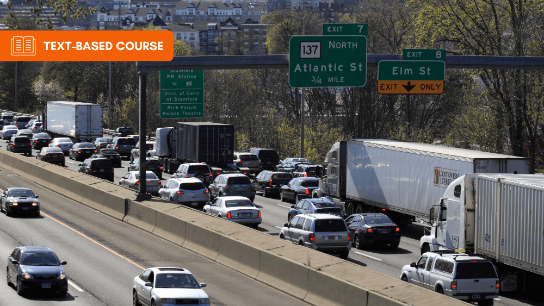
Although many of the nation’s traffic bottlenecks must be addressed through costly major construction projects or expensive alternatives such as high-occupancy vehicle lanes, dynamic pricing, or transit alternatives, a significant opportunity exists for applying operational and low-cost solutions at specific locations. This course is based on a primer produced by the Localized Bottleneck Reduction program of the Federal Highway Administration.
The course focuses on recurring congestion choke-points and the operational influences that cause them. Widening, lengthening, retiming, metering, or bypassing problem areas can often be done with lower cost and less intensive means than required by completely rebuilding the system.
These options and other low cost alternatives are described in the course. Examples of how some state agencies are dealing with bottlenecks are given.
Topics: This course teaches the following specific knowledge and skills: Identifying and assessing bottlenecks Understanding how bottlenecks form and disperse Understanding merging at recurring bottlenecks Understanding merge principles Understanding and evaluating low-cost bottleneck improvement strategies Learning how some state agencies are dealing with some specific bottlenecks
Civil Engneering faculty member for 27 years
Dr. Rossow is a graduate of the University of Michigan with B.S., M.S., and Ph.D. degrees. He is a licensed Professional Engineer in the State of Illinois. He taught civil engineering for over 35 years, including six years at Washington University in St. Louis and 29 years at Southern Illinois University Edwardsville, where he was the Chair of the Civil Engineering Department for ten years. His areas of expertise are in civil engineering and mechanics. He has consulted for various organizations, including government agencies and an international offshore drilling company. He has published numerous technical journal articles and technical reports for a variety of governmental agencies and private sector organizations. Mark P. Rossow, PE, PhD Licensed Professional Engineer in State of Illinois License No. 062.040560 Dr. Rossow is a graduate of the University of Michigan with B.S., M.S., and Ph.D. degrees. He taught civil engineering for over 35 years, including six years at Washington University in St. Louis and 29 years at Southern Illinois University Edwardsville, where he was the Chair of the Civil Engineering Department for ten years. His areas of expertise are in civil engineering and mechanics. He has consulted for various organizations, including government agencies and an international offshore drilling company. He has published many journal articles and technical reports.
This portal is provided as a training and development resource for City of Markham employees. Every course is delivered by a qualified subject matter expert or learning organization, is quantifiable in hours, and is verifiable — you receive a documented certificate of completion for every course you finish, stored on LearnFormula indefinitely.
If you hold a professional designation (for example in engineering, accounting, human resources, or law), courses may be counted as professionally relevant, verifiable learning activities toward your continuing professional development. Individual practitioners are responsible for confirming that an activity meets the requirements of their professional body. For questions about the City of Markham's training and development policies, please speak with your people leader or Human Resources.
