Master Reliability-Centered Maintenance to eliminate costly downtime, optimize asset lifecycles, and drive peak performance across your industrial 3D printing operations.
Additive manufacturing has evolved from a rapid prototyping tool into a viable production technology used across aerospace, medical, energy, and advanced manufacturing sectors. As organisations increasingly rely on additive manufacturing for critical components, attention is shifting from proving technical feasibility to achieving consistent, repeatable, safe, and economically sustainable production outcomes. In this environment, equipment reliability, powder quality, process stability, and maintenance practices play a direct role in determining final part quality and operational performance.
This session examines how reliability-centred maintenance (RCM) principles can be applied to additive manufacturing operations to improve equipment availability, process consistency, and production reliability. Drawing on established RCM methodologies and industry standards, the webinar explores how maintenance strategies can move beyond traditional OEM recommendations toward risk-based approaches that align maintenance activities with operational objectives. Participants will gain practical insight into developing maintenance frameworks that support both manufacturing performance and long-term asset reliability.
Key Topics Discussed

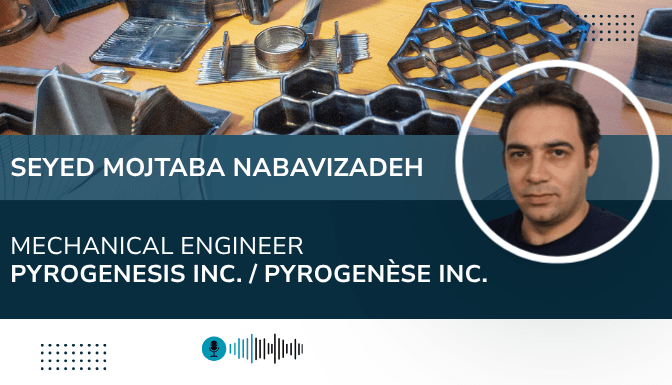
Mechanical Engineer | PyroGenesis Inc. / PyroGenèse inc.
With a solid background in mechanical engineering and a strong commitment to operational excellence, I currently serve as a Mechanical Engineer at PyroGenesis Canada Inc. My role bridges engineering design and practical field execution, allowing me to contribute to projects focused on reliability, continuous improvement, and system optimization. From equipment performance analysis to troubleshooting complex mechanical systems, I apply a hands-on, data-driven approach that enhances productivity and equipment uptime. I specialize in developing and implementing effective preventive and predictive maintenance strategies that align with the company’s vision of innovation in additive manufacturing. At PyroGenesis, I am proud to support a culture of technical excellence, where my expertise in maintenance engineering, inspection, and process optimization drives tangible results in a high-tech manufacturing environment.
This portal is provided as a training and development resource for City of Markham employees. Every course is delivered by a qualified subject matter expert or learning organization, is quantifiable in hours, and is verifiable — you receive a documented certificate of completion for every course you finish, stored on LearnFormula indefinitely.
If you hold a professional designation (for example in engineering, accounting, human resources, or law), courses may be counted as professionally relevant, verifiable learning activities toward your continuing professional development. Individual practitioners are responsible for confirming that an activity meets the requirements of their professional body. For questions about the City of Markham's training and development policies, please speak with your people leader or Human Resources.
