Unlock the secrets of complex series, parallel, and bridge networks with expert analysis techniques.
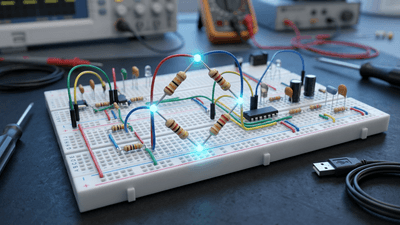
Unlock the foundational secrets of electrical circuit design with "DC Series: Parallel Network Analysis." This comprehensive course is designed to take your understanding of direct current (DC) circuits to the next level by bridging the gap between basic electrical concepts and complex, real-world systems.
Dive deep into the behavior, calculation, and troubleshooting of intricate electrical networks that combine both series and parallel configurations. Through a blend of theoretical principles and practical, step-by-step problem-solving, you will master the essential techniques needed to simplify and analyze multi-branch circuits. You will learn how to confidently apply Ohm’s Law, Kirchhoff’s Current Law (KCL), and Kirchhoff’s Voltage Law (KVL) to accurately calculate equivalent resistance, total current, branch currents, voltage drops, and power dissipation.
Whether you are an engineering student looking to solidify your fundamentals, an electronics hobbyist building custom projects, or an aspiring technician aiming to sharpen your diagnostic skills, this course equips you with the analytical tools required to evaluate and troubleshoot DC systems with absolute precision and confidence. Master the logic behind the circuits and power up your electrical engineering journey today.

An entire career in the power sector of engineering, Graham graduated from Queen's university coupled with subsequent studies with Wilfrid Laurier University to travel the globe and apply his skills and garner his protection and control experience internationally. His passion for staying in touch with his profession and his kinship for mentoring has kept him in front of an audience of learners.
This portal is provided as a training and development resource for City of Markham employees. Every course is delivered by a qualified subject matter expert or learning organization, is quantifiable in hours, and is verifiable — you receive a documented certificate of completion for every course you finish, stored on LearnFormula indefinitely.
If you hold a professional designation (for example in engineering, accounting, human resources, or law), courses may be counted as professionally relevant, verifiable learning activities toward your continuing professional development. Individual practitioners are responsible for confirming that an activity meets the requirements of their professional body. For questions about the City of Markham's training and development policies, please speak with your people leader or Human Resources.
