Simplify complex fall protection math and learn foolproof methods to determine accurate drop distances, ensure compliance, and keep your crew safe at any height.
Fall protection systems are only effective when the underlying calculations are correct. Misjudging fall clearance, anchor location, swing fall exposure, or system behaviour can turn a compliant-looking design into a serious safety risk. Yet many engineers and safety professionals still rely on oversimplified rules of thumb that fail under real-world conditions.
This practical session provides a clearer framework for understanding and performing fall clearance calculations in engineering and industrial environments. It examines how active fall protection systems behave during arrest events, how clearance requirements are determined for different configurations, and how engineers identify and avoid the calculation errors that most commonly lead to unsafe system design.
Key Topics Discussed:

President | Elevated Insight and Engineering Ltd.
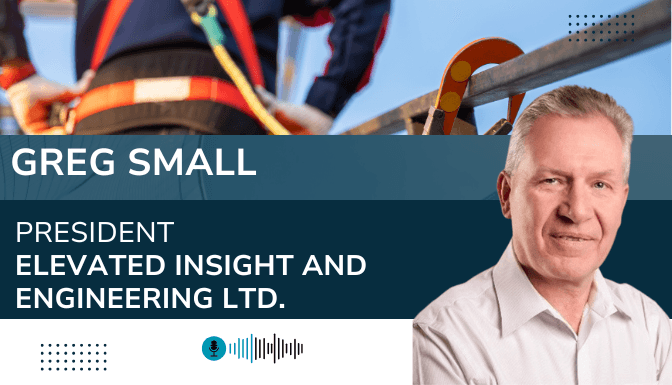
Greg Small is highly respected as one of the leading Fall Protection engineering experts in the World. Approximately one-third of presenters at the last ten “International Society for Fall Protection” Symposiums have received Fall Protection Engineering Training from Greg. In 1991, Greg was appointed to the Canadian Standards Association Z259 technical committee on fall protection and served on its executive for more than 10 years, stepping down as its vice-chair in 2016. He has played a very active role in the development of standards in fall protection. He has made significant contributions to the last two editions of Z259.13, “Flexible Horizontal Lifeline Systems”, and chaired the first edition of Z259.15, “Anchorage Connectors”. His proudest achievement, however, was conceiving and chairing the original and all subsequent editions of Z259.16, for the “Design of Active Fall Protection Systems”. This ground-breaking standard was adopted, almost verbatim, as ANSI Z359.6-09 in the United States and SS607 in Singapore. At ANSI Z359, Greg stepped down as chair of ANSI Z359.18, “Anchorage Connectors” in 2020 but remains a very active participant in that and many other standards, particularly ANSI Z359.6 (“Design of Active Fall Protection Systems”) and ANSI Z359.17 (“Horizontal Lifelines”). Greg incorporated “Elevated Insight and Engineering Ltd.” in September 2016, in service of the fall protection industry. He remains active with CSA Z259 and ANSI Z359 and consults to engineering firms, manufacturers and regulators. He serves as an expert witness in a variety of liability cases, and offers his industry-leading training in “Qualified Fall Protection Engineer” and “Competent Person Advanced”. He has participated in many forensic investigations of incidents, accidents, equipment failures, design flaws, and mis-use of equipment and systems.
This portal is provided as a training and development resource for City of Markham employees. Every course is delivered by a qualified subject matter expert or learning organization, is quantifiable in hours, and is verifiable — you receive a documented certificate of completion for every course you finish, stored on LearnFormula indefinitely.
If you hold a professional designation (for example in engineering, accounting, human resources, or law), courses may be counted as professionally relevant, verifiable learning activities toward your continuing professional development. Individual practitioners are responsible for confirming that an activity meets the requirements of their professional body. For questions about the City of Markham's training and development policies, please speak with your people leader or Human Resources.
