The 1972 legislation known as the Clean Water Act set secondary treatment as the required level of treatment to be provided by domestic wastewater treatment plants in the United States.
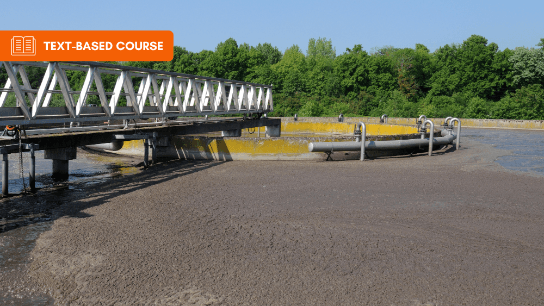
The 1972 legislation known as the Clean Water Act set secondary treatment as the required level of treatment to be provided by domestic wastewater treatment plants in the United States. In this course you can learn about the basic processes used in primary and secondary wastewater treatment, processes used and contaminants removed by advanced treatment, treatment & disposal or beneficial reuse of biosolids (wastewater sludge), and the fundamentals of onsite wastewater treatment systems.
Topics: At the conclusion of this course, the student will: Be familiar with the wastewater treatment requirements set by the Clean Water Act and subsequent related legislation. Know the types of pollutants typically present in domestic wastewater. Know the processes used in preliminary and primary wastewater treatment. Know the process alternatives for secondary wastewater treatment. Know the alternative methods for land treatment of wastewater. Be familiar with the disinfection processes used for wastewater. Know the pollutants typically removed by advanced treatment and the processes used for their removal. Know the general treatment processes and disposal & beneficial reuse methods for wastewater biosolids. Know the alternative processes for onsite wastewater treatment.
Intended Audience: for civil, municipal, and environmental engineers, as well as anyone interested in or involved with wastewater treatment. An attendee of this course will gain knowledge about the processes used in domestic wastewater treatment. Publication Source: US Environmental Protection Agency

Dr. Harlan Bengtson is an online PDH course provider of continuing education courses for professional engineers. Dr. Bengtson is a graduate of Iowa State University with B.S. and M.S. degrees and of the University of Colorado with a PhD. He is a licensed Professional Engineer in Missouri. Dr. Bengtson has spent 30 years in engineering education in teaching and administrative positions, including six years as Dean of Engineering at Southern Illinois University Edwardsville. Dr. Harlan H. Bengtson, PE 33 Grainey Drive Glen Carbon, IL 62034 Phone: (618) 406-6892 E-mail: hnkbengtson@yahoo.com PROFESSIONAL PROFILE Dr. Bengtson is a graduate of Iowa State University with B.S. and M.S. degrees and of the University of Colorado with a PhD. He is a licensed Professional Engineer in Missouri. He has spent 30 years in engineering education in teaching and administrative positions, including six years as Dean of Engineering at Southern Illinois University Edwardsville. His areas of expertise are environmental engineering, hydrology and hydraulics, engineering science and renewable energy systems. He has done regular consulting work while holding the academic positions. Prior to entering academia, Dr. Bengtson worked for Minnesota Mining & Manufacturing as a Product Development Engineer and for E. I. duPont deNemours as a Process Development Engineer. Dr. Bengtson has authored numerous publications, presentations and technical reports. He is currently active as a freelance technical writer, author of continuing education courses for Professional Engineers, and is the founder of www.engineeringexceltemplates.com and www.EngineeringExcelSpreadsheets.com, sites with the objective of providing inexpensive, easy to use Excel spreadsheets for a variety of engineering calculations.
This portal is provided as a training and development resource for City of Markham employees. Every course is delivered by a qualified subject matter expert or learning organization, is quantifiable in hours, and is verifiable — you receive a documented certificate of completion for every course you finish, stored on LearnFormula indefinitely.
If you hold a professional designation (for example in engineering, accounting, human resources, or law), courses may be counted as professionally relevant, verifiable learning activities toward your continuing professional development. Individual practitioners are responsible for confirming that an activity meets the requirements of their professional body. For questions about the City of Markham's training and development policies, please speak with your people leader or Human Resources.
