The activated sludge process is very widely used for biological wastewater treatment.
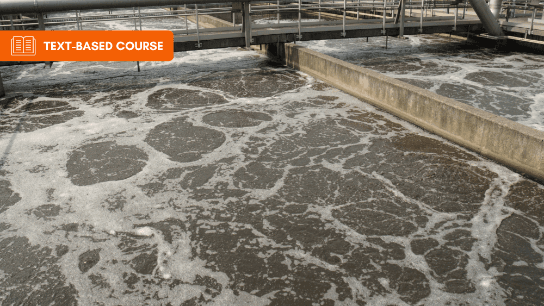
The activated sludge process is very widely used for biological wastewater treatment. This course includes background on biological wastewater treatment, a general description of the activated sludge process, information about several variations of the activated sludge process, discussion of design calculations for an activated sludge aeration tank, and discussion of activated sludge operational calculations. Example calculations and discussion of using an Excel spreadsheet for making the calculations are also included.
Topics: At the conclusion of this course, the student will: Know the equation for biological oxidation and how it fits into the organic carbon cycle Know the equation for photosynthesis and how it fits into the organic carbon cycle Know the major components of an activated sludge wastewater treatment system Be able to describe the differences between extended aeration and conventional activated sludge system Be able to describe the differences between a contact stabilization and conventional activated sludge system Be able to calculate required aeration tank volume (in U.S. units) for a specified volumetric loading, hydraulic residence time, or aeration tank F:M ratio, if given suitable aeration tank influent and aeration tank parameter information. Be able to calculate required aeration tank volume (in S.I. units) for a specified volumetric loading, hydraulic residence time, or aeration tank F:M ratio, if given suitable aeration tank influent and aeration tank parameter information. Be able to calculate the required activated sludge recycle flow rate, waste activated sludge flow rate, and aeration tank F:M ratio, if given suitable wastewater stream and aeration tank information along with the desired value for sludge retention time.
Intended Audience: This course is intended for civil engineers, environmental engineers, and chemical engineers. After completing this course you will be familiar with the common variations of the activated sludge process used for biological wastewater treatment and be able to make typical aeration tank design and operational calculations.
Publication Source: Based on original courseware, written by Harlan Bengtson, PhD, PE
Dr. Harlan Bengtson is an online PDH course provider of continuing education courses for professional engineers. Dr. Bengtson is a graduate of Iowa State University with B.S. and M.S. degrees and of the University of Colorado with a PhD. He is a licensed Professional Engineer in Missouri. Dr. Bengtson has spent 30 years in engineering education in teaching and administrative positions, including six years as Dean of Engineering at Southern Illinois University Edwardsville. Dr. Harlan H. Bengtson, PE 33 Grainey Drive Glen Carbon, IL 62034 Phone: (618) 406-6892 E-mail: hnkbengtson@yahoo.com PROFESSIONAL PROFILE Dr. Bengtson is a graduate of Iowa State University with B.S. and M.S. degrees and of the University of Colorado with a PhD. He is a licensed Professional Engineer in Missouri. He has spent 30 years in engineering education in teaching and administrative positions, including six years as Dean of Engineering at Southern Illinois University Edwardsville. His areas of expertise are environmental engineering, hydrology and hydraulics, engineering science and renewable energy systems. He has done regular consulting work while holding the academic positions. Prior to entering academia, Dr. Bengtson worked for Minnesota Mining & Manufacturing as a Product Development Engineer and for E. I. duPont deNemours as a Process Development Engineer. Dr. Bengtson has authored numerous publications, presentations and technical reports. He is currently active as a freelance technical writer, author of continuing education courses for Professional Engineers, and is the founder of www.engineeringexceltemplates.com and www.EngineeringExcelSpreadsheets.com, sites with the objective of providing inexpensive, easy to use Excel spreadsheets for a variety of engineering calculations.
This portal is provided as a training and development resource for City of Markham employees. Every course is delivered by a qualified subject matter expert or learning organization, is quantifiable in hours, and is verifiable — you receive a documented certificate of completion for every course you finish, stored on LearnFormula indefinitely.
If you hold a professional designation (for example in engineering, accounting, human resources, or law), courses may be counted as professionally relevant, verifiable learning activities toward your continuing professional development. Individual practitioners are responsible for confirming that an activity meets the requirements of their professional body. For questions about the City of Markham's training and development policies, please speak with your people leader or Human Resources.
