The pumps widely used in industry, and by commercial buildings and municipalities, can almost all be classified as either centrifugal pumps or positive displacement pumps.
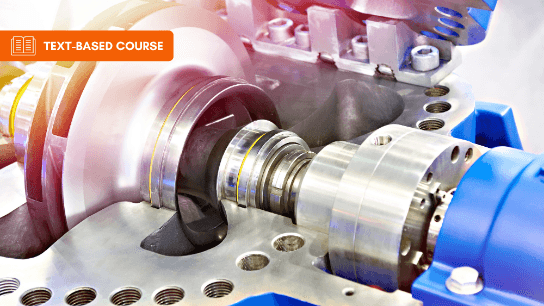
The pumps widely used in industry, and by commercial buildings and municipalities, can almost all be classified as either centrifugal pumps or positive displacement pumps. The general components and operating characteristics of these two types of pumps are covered in this course, along with discussion of corrective and preventive measures for various pumping problems.
Topics: Functions of the following centrifugal pump components: impeller, volute, diffuser, packing, lantern ring, and wearing ring. Causes, symptoms and corrective measures for cavitation in a centrifugal pump The meaning of and measures to prevent gas binding, deadheading, and pump runout for centrifugal pumps Differences in operating characteristics between centrifugal and positive displacement pumps General nature of operating curves for centrifugal and positive displacement pumps the meaning of the term slippage as applied to positive displacement pumps. Different types of positive displacement pumps Learn how positive displacement pumps are protected against over-pressurization
Intended Audience: for mechanical, industrial, civil, chemical, environmental, and other engineers whose job description may require a general knowledge of centrifugal and displacement pump systems.
Publication Source: Dept. of Energy

Dr. Harlan Bengtson is an online PDH course provider of continuing education courses for professional engineers. Dr. Bengtson is a graduate of Iowa State University with B.S. and M.S. degrees and of the University of Colorado with a PhD. He is a licensed Professional Engineer in Missouri. Dr. Bengtson has spent 30 years in engineering education in teaching and administrative positions, including six years as Dean of Engineering at Southern Illinois University Edwardsville. Dr. Harlan H. Bengtson, PE 33 Grainey Drive Glen Carbon, IL 62034 Phone: (618) 406-6892 E-mail: hnkbengtson@yahoo.com PROFESSIONAL PROFILE Dr. Bengtson is a graduate of Iowa State University with B.S. and M.S. degrees and of the University of Colorado with a PhD. He is a licensed Professional Engineer in Missouri. He has spent 30 years in engineering education in teaching and administrative positions, including six years as Dean of Engineering at Southern Illinois University Edwardsville. His areas of expertise are environmental engineering, hydrology and hydraulics, engineering science and renewable energy systems. He has done regular consulting work while holding the academic positions. Prior to entering academia, Dr. Bengtson worked for Minnesota Mining & Manufacturing as a Product Development Engineer and for E. I. duPont deNemours as a Process Development Engineer. Dr. Bengtson has authored numerous publications, presentations and technical reports. He is currently active as a freelance technical writer, author of continuing education courses for Professional Engineers, and is the founder of www.engineeringexceltemplates.com and www.EngineeringExcelSpreadsheets.com, sites with the objective of providing inexpensive, easy to use Excel spreadsheets for a variety of engineering calculations.
This portal is provided as a training and development resource for City of Markham employees. Every course is delivered by a qualified subject matter expert or learning organization, is quantifiable in hours, and is verifiable — you receive a documented certificate of completion for every course you finish, stored on LearnFormula indefinitely.
If you hold a professional designation (for example in engineering, accounting, human resources, or law), courses may be counted as professionally relevant, verifiable learning activities toward your continuing professional development. Individual practitioners are responsible for confirming that an activity meets the requirements of their professional body. For questions about the City of Markham's training and development policies, please speak with your people leader or Human Resources.
