This course is intended for highway engineers, planners, and decision-makers involved with the planning, design, and operation of high-volume, signalized intersections.
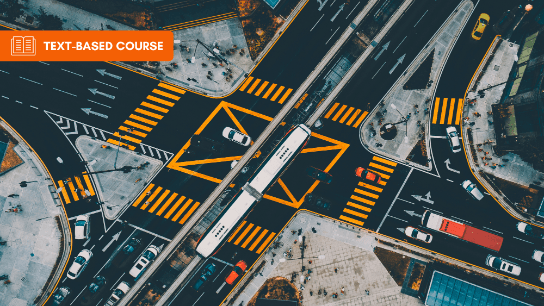
This online traffic engineering PDH course describes how congestion-related problems can be solved by using alternative methods—methods that differ from the conventional approach of adding capacity to an intersection simply by adding lanes. The conventional approach has diminishing returns. For instance, while the addition of a second through-lane might extend the life of an intersection by 15 years before it reaches capacity, adding a third through-lane provides only 10 years, and a fourth through-lane extends the life by just 6 years. Large intersections also increase loss time due to longer clearance intervals, protected left turn phasing, longer pedestrian clearance times, greater imbalances in lane utilization, and potential queue blockages caused by longer cycle lengths. Each of these issues highlights the need to explore alternative treatments.
This course describes reconstruction treatments for signalized intersections in three categories: intersection reconfiguration, at-grade indirect movements, and grade separation. Many of these treatments are commonplace, while others have seen limited or regional use. The common element in each treatment is the reduction in conflict points at the intersection, which provides safety and operational benefits by reducing the number of phases and conflicting volume at a single location.
Topics:
Civil Engneering faculty member for 27 years
Dr. Rossow is a graduate of the University of Michigan with B.S., M.S., and Ph.D. degrees. He is a licensed Professional Engineer in the State of Illinois. He taught civil engineering for over 35 years, including six years at Washington University in St. Louis and 29 years at Southern Illinois University Edwardsville, where he was the Chair of the Civil Engineering Department for ten years. His areas of expertise are in civil engineering and mechanics. He has consulted for various organizations, including government agencies and an international offshore drilling company. He has published numerous technical journal articles and technical reports for a variety of governmental agencies and private sector organizations. Mark P. Rossow, PE, PhD Licensed Professional Engineer in State of Illinois License No. 062.040560 Dr. Rossow is a graduate of the University of Michigan with B.S., M.S., and Ph.D. degrees. He taught civil engineering for over 35 years, including six years at Washington University in St. Louis and 29 years at Southern Illinois University Edwardsville, where he was the Chair of the Civil Engineering Department for ten years. His areas of expertise are in civil engineering and mechanics. He has consulted for various organizations, including government agencies and an international offshore drilling company. He has published many journal articles and technical reports.
This portal is provided as a training and development resource for City of Markham employees. Every course is delivered by a qualified subject matter expert or learning organization, is quantifiable in hours, and is verifiable — you receive a documented certificate of completion for every course you finish, stored on LearnFormula indefinitely.
If you hold a professional designation (for example in engineering, accounting, human resources, or law), courses may be counted as professionally relevant, verifiable learning activities toward your continuing professional development. Individual practitioners are responsible for confirming that an activity meets the requirements of their professional body. For questions about the City of Markham's training and development policies, please speak with your people leader or Human Resources.
