Intended for civil, transportation, land planning, and other engineers whose job description may require a general knowledge of the design of parking spaces which comply with ADA standards.
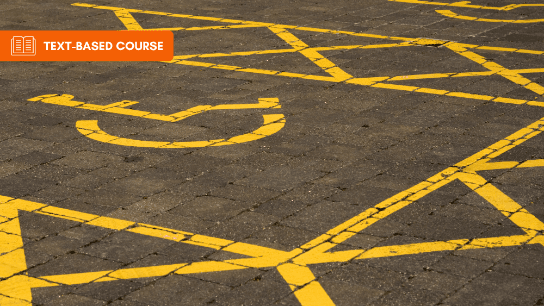
This course provides detailed information on designing accessible parking spaces that meet the requirements of the Americans with Disabilities Act as defined by the 2010 ADA Standards for Accessible Design. Both vans and cars are considered. Dimensions, distribution, location, connections to access routes (to accessible entrances to buildings), and minimum number of spaces are all described. Special requirements for making temporary events (such as street festivals, craft fairs, musical performances, sporting events and home shows) accessible are also presented.
Topics: Temporary accessible parking spaces Aisle width, vertical clearance, and signage for van accessible parking spaces Relation of access aisle to accessible route Requirements for access route Location and distribution of parking spaces Number of van accessible spaces relative to accessible spaces Readily achievable barrier removal Minimum number of accessible parking spaces Requirements when restriping parking lots Dealing with problem curb ramps Intended Audience: for civil, transportation, land planning, and other engineers whose job description may require a general knowledge of the design of parking spaces which comply with ADA standards.
Civil Engneering faculty member for 27 years
Dr. Rossow is a graduate of the University of Michigan with B.S., M.S., and Ph.D. degrees. He is a licensed Professional Engineer in the State of Illinois. He taught civil engineering for over 35 years, including six years at Washington University in St. Louis and 29 years at Southern Illinois University Edwardsville, where he was the Chair of the Civil Engineering Department for ten years. His areas of expertise are in civil engineering and mechanics. He has consulted for various organizations, including government agencies and an international offshore drilling company. He has published numerous technical journal articles and technical reports for a variety of governmental agencies and private sector organizations. Mark P. Rossow, PE, PhD Licensed Professional Engineer in State of Illinois License No. 062.040560 Dr. Rossow is a graduate of the University of Michigan with B.S., M.S., and Ph.D. degrees. He taught civil engineering for over 35 years, including six years at Washington University in St. Louis and 29 years at Southern Illinois University Edwardsville, where he was the Chair of the Civil Engineering Department for ten years. His areas of expertise are in civil engineering and mechanics. He has consulted for various organizations, including government agencies and an international offshore drilling company. He has published many journal articles and technical reports.
This portal is provided as a training and development resource for City of Markham employees. Every course is delivered by a qualified subject matter expert or learning organization, is quantifiable in hours, and is verifiable — you receive a documented certificate of completion for every course you finish, stored on LearnFormula indefinitely.
If you hold a professional designation (for example in engineering, accounting, human resources, or law), courses may be counted as professionally relevant, verifiable learning activities toward your continuing professional development. Individual practitioners are responsible for confirming that an activity meets the requirements of their professional body. For questions about the City of Markham's training and development policies, please speak with your people leader or Human Resources.
